
Author: dfarrugia

  • The 30% Promise: What the PN Is Actually Proposing on Energy — and Who Is Right About the Numbers

    The 30% Promise: What the PN Is Actually Proposing on Energy — and Who Is Right About the Numbers

    Of all the proposals launched in the 2026 election campaign, the Nationalist Party’s pledge to cut household electricity bills by 30% has generated the most heat — and the least light. The Labour Party called the numbers “amateurish.” Former Prime Minister Joseph Muscat published a lengthy social media critique. PN leader Alex Borg held a full press conference to defend the detail. In between, a series of claims, counter-claims and partial calculations have left the public no clearer on what the proposal actually involves or whether it stands up.

    This article attempts what the political debate has not: a complete, line-by-line fact-check of every figure in the PN proposal, based solely on published primary sources. The conclusion is that the PN’s core financial case — once properly understood — is considerably stronger than its critics acknowledged. It is also more limited in scope for certain groups of consumers than the headline figure implies. Both sides of this debate have been talking past each other.


    What Malta’s Electricity System Currently Looks Like

    Malta’s electricity is supplied exclusively by Enemalta plc. According to NSO Malta’s official 2024 electricity supply data, the generation mix comprised 58.1% net output from power stations (natural gas and marginal diesel at Delimara), 31.1% net imports via the Malta–Sicily interconnector — which surged 49.7% on 2023 — and 10.8% from renewable energy, mainly solar PV. Total electricity supplied reached 3,106.1 GWh, up 6.5% on 2023.

    Two statistics that neither party has addressed in this debate deserve to be stated plainly. According to the Eurostat Energy in Europe 2026 edition, Malta has the highest share of fossil fuels in electricity production in the entire European Union, at 85%. It also has the highest energy import dependency in the EU, at 98%. These are not background details — they are the structural vulnerabilities that any serious energy debate must address.

    The current residential tariff structure, published under S.L. 545.41, sets two main bands: Band 1 (0–2,000 kWh per year) at 10.47c per unit including VAT, and Band 2 (2,001–6,000 kWh per year) at 12.98c per unit. The annual service charge for a single-phase residential meter is €65. These tariffs are set well below Enemalta’s actual cost of generation, with the difference subsidised by government at an estimated €320 million per year.

    Malta currently has the second cheapest household electricity in the European Union — only Hungary is cheaper at €10.40 per 100 kWh. Malta’s price stands at €12.44 per 100 kWh, against an EU average of €28.72, meaning Malta pays just 43% of the EU average. The reason is the government subsidy. That subsidy is, in the words of both the IMF and the European Commission, fiscally unsustainable.


    The PN Proposal: Four Components

    The Nationalist Party’s package has four distinct components. Understanding each separately is essential to evaluating the proposal honestly.

    Component 1: Removal of Annual Meter Rental Charges

    Shadow minister Mark Anthony Sammut confirmed at the 4 May press conference that the annual electricity meter rental fee would be removed for all 228,000 residential properties in Malta, at an annual cost of approximately €17 million. The fee currently ranges from €65 per year for single-phase properties to €195 for 60-amp three-phase connections. Farmers and voluntary organisations would also benefit, with the non-residential fee of up to €360 per year also removed.

    Verdict: CONFIRMED. The figures are consistent with Enemalta’s published tariff schedule. The €17 million cost is arithmetically sound: 228,000 residences at a blended average of approximately €75 per property equals approximately €17.1 million per year.

    Component 2: Removal of the Second Residential Tariff Band

    The PN would remove the second tier of energy pricing (12.98c per unit), which currently applies to consumption above 2,000 kWh per year. This would extend the first-tier rate of 10.47c to cover the full range of 0 to 6,000 units consumed annually. The PN estimates this costs €8 million per year.

    For a typical household consuming, say, 4,000 kWh per year — 2,000 units in each band — the annual saving from this change alone is: 2,000 units × (12.98c − 10.47c) = 2,000 × 2.51c = €50.20 per year. Combined with the meter charge removal, total saving = €115.20 per year on a €534.00 current bill = 21.6%.

    Verdict: CONFIRMED. The 21% average saving cited by the PN for typical multi-person households is arithmetically correct across the Band 2 consumption range (20.8% at 6,000 kWh, 23.7% at 2,000 kWh). The €8 million cost figure is credible.

    Component 3: Eco-Reduction Threshold Extension for Single-Person Households

    This is the component that has received the least media attention — and it is the one that produces the most significant savings for one of Malta’s most financially vulnerable groups.

    Under current rules (S.L. 545.41), a single person living alone receives a 25% eco-reduction on their consumption charges, but only if annual consumption is below 2,000 kWh. The moment they exceed that threshold — which happens easily in the age of remote working, induction cookers and air conditioning — they lose the eco-reduction entirely, while simultaneously entering the higher Band 2 tariff rate. They are penalised twice at once.

    The PN stated at the 4 May 2026 press conference that the threshold would be raised from 2,000 to 3,000 kWh. Borg gave the reason plainly: single people now work from home and use induction ovens, air conditioning and televisions in the same way larger households do. A single person cannot use half a television. ENERGIA-1 independently verified: with a 3,000 kWh threshold, the combined effect of band reform, meter removal and eco-reduction produces a 42.1% saving for a single person consuming 2,500 kWh — as shown in the calculation below.

    The arithmetic for a single person currently consuming 2,500 kWh per year — just above the threshold where they lose their eco-reduction — is as follows:

    Current bill: Band 1 (2,000 × €0.1047 = €209.40) + Band 2 (500 × €0.1298 = €64.90) + service charge €65.00 = €339.30. Eco-reduction: zero, because consumption exceeds the 2,000 kWh threshold.

    Under PN proposal: All 2,500 kWh at Band 1 rate = €261.75. Eco-reduction now applies (2,500 < new 3,000 threshold): −25% × €261.75 = −€65.44. Service charge: removed. Total: €196.31.

    Saving: €142.99 = 42.1%.

    This holds consistently across the 2,001–3,000 kWh range, producing savings of between 41.7% and 42.6%. It is precisely this group that the PN’s eco-reduction extension targets — and it is arithmetically correct.

    Critical limitation: For single persons consuming more than 3,000 kWh per year, the eco-reduction extension does not apply. Their saving reverts to approximately 21–22% — the same as a multi-person household. The 42% saving is specific to the 2,001–3,000 kWh consumption band.

    Verdict: CONFIRMED for 2,001–3,000 kWh range. The PN stated at the press conference that the eco-contribution threshold for single persons would rise from 2,000 to 3,000 units, with qualifying households seeing average reductions of 42%. ENERGIA-1 independent arithmetic confirms: across the 2,001–3,000 kWh band the saving ranges from 41.7% to 42.6% — fully consistent with the stated figure.

    Component 4: €60 Million Solar Investment

    The PN proposes a one-time capital investment of €60 million to install solar panels on government property, schools and public car parks — explicitly confirmed as excluding agricultural land. The target is 175 GWh of annual generation.

    Engineering verification: Malta receives approximately 1,800 peak sun hours per year. Required installed capacity: 175,000,000 kWh ÷ 1,800 hours = approximately 97 MWp. At modern panel efficiency of 185 W/m², this requires approximately 525,000 m² of panel area, or approximately 630,000 m² including installation spacing. Cost: €60 million ÷ 97 MWp = approximately €618 per kWp — achievable for large-scale installation.

    175 GWh as a share of national supply: 175 GWh ÷ 3,106.1 GWh = 5.6%. The PN’s “around 5%” is accurate.


    The Self-Funding Mechanism — This Is the Key

    The most important part of the PN proposal, and the one least clearly explained in the public debate, is how the €60 million solar investment funds the entire package of tariff reforms.

    The PN stated at the press conference that the average cost of energy to Enemalta is 21c per unit, comprising 15c for generation, 4c for distribution, and 2c for carbon-related costs. The investment in solar panels on government buildings, schools and car parks would remove most of the generation and carbon costs — reducing the price by 17c per unit.

    The arithmetic is as follows: 17c × 175,000,000 kWh = €29,750,000 per year — approximately €30 million. This is essentially exact: the solar investment produces annual savings of €30 million on Enemalta’s generation and carbon costs, and those €30 million fund the three components of the tariff package (€17M meter rental + €8M Band 2 removal + ~€5M eco extension).

    This is a self-funding model in recurrent terms — the ongoing annual savings cover the ongoing annual cost of the tariff reforms. The upfront €60 million capital cost remains a separate question: the PN has not stated whether this comes from government reserves, borrowing, or EU funds, and interest costs are not included in any party’s analysis.

    Why did this cause such confusion? Because the PL’s critique compared 17c with the wrong baseline. The 17c is not the saving to consumers on their retail bills — it is the saving to Enemalta on its internal generation cost. Malta’s retail tariffs are set below Enemalta’s actual generation cost, with the subsidy making up the difference. The solar investment reduces that subsidy burden by €30 million per year, enabling the tariff reforms to be fiscally neutral.

    The Labour Party was therefore technically correct that the retail bill saving per unit is not 17c — but this misses the point of what the PN was saying. The PN measured the saving against Enemalta’s full generation cost, not the subsidised retail price. ENERGIA-1 arithmetic confirms the PN’s metric is correct: 17c × 175,000,000 kWh = €29,750,000 per year.


    Labour’s Rebuttal: What It Got Right and What It Missed

    Energy Minister Miriam Dalli described the PN’s proposals as “amateurish” and said “the numbers don’t add up.” The PL’s specific claims were:

    “Solar savings are less than half of what was claimed.” On a retail tariff displacement basis only — measuring the saving against the subsidised consumer price — this is directionally true. At current retail rates, 175 GWh displaced saves approximately €17–23 million per year on consumer bills. But this is not the metric the PN used. The PN measured the saving against Enemalta’s full generation cost (21c per unit), of which solar eliminates 17c. On that correct basis, the saving is €29.75 million — exactly as the PN stated. This critique was based on a misunderstanding of the proposal.

    “€60M cannot generate €30M/year forever.” Correct: solar panels have a lifespan of 25–30 years and degrade at approximately 0.5% per year. The savings are not “forever.” However, over the panel’s working life, the cumulative saving substantially exceeds the capital cost. This is a fair observation but does not undermine the financial case. Partially valid.

    “€10 per month saving is not 30% of bills.” For multi-person households — where the saving is approximately 21% — this is fair. But the PL failed to address the eco-reduction extension at all, which produces 42% savings for a specific and significant group of single-person consumers. The PL never rebutted this component. Incomplete — the PL ignored the eco-reduction extension entirely.


    Joseph Muscat’s Critique: What He Got Right and What He Got Wrong

    Joseph Muscat is currently facing criminal proceedings in Malta relating to the Vitals/Steward hospital concession.

    On roof space: Muscat claimed 2 million square metres of roof space would be required. The engineering calculation gives approximately 630,000 m² — Muscat’s figure overstates the requirement by a factor of approximately three. His associated claim about “150 times the Floriana Fosos” is similarly inflated; the correct comparison is approximately 40–50 times. Wrong.

    On financial returns: Muscat’s argument that €60M cannot generate €30M per year does not hold against the arithmetic. The PN’s stated cost breakdown — 15c generation + 2c carbon = 17c eliminated by solar — produces: 17c × 175,000,000 kWh = €29,750,000 per year. ENERGIA-1 independently cross-checks: Malta’s ETS carbon cost (0.70 MtCO2 × €64.8/t ÷ 1,849.9 GWh = 2.45c/kWh) is consistent with the stated 2c. Wrong — the figure is arithmetically confirmed.

    On publishing a building list: Muscat’s challenge to the PN to publish a list of specific government buildings earmarked for the installation remains the most legitimate question in the entire debate. The PN has confirmed car parks, schools and government property — but has not published a specific inventory. Engineering analysis suggests that available government rooftop space may be between 310,000 and 525,000 m², potentially falling 5–52% short of the ~630,000 m² required unless car park canopies and non-traditional surfaces are fully included. Legitimate — unresolved.


    The Numbers No One Is Talking About

    Several financially significant facts are absent from the entire public debate.

    Malta’s EU ETS carbon burden. Enemalta pays approximately €45 million per year in EU Emissions Trading System carbon allowances — 100% attributable to gas-fired electricity generation, calculated at 0.70 MtCO2 in 2024 multiplied by €64.8 per tonne (2024 average, EEA). Carbon prices are currently around €75 per tonne and are projected to reach €100–€150 per tonne by 2030. The PN’s solar investment would reduce this burden by approximately €4–5 million per year — already factored into the 2c carbon cost within the 17c saving.

    EU infringement proceedings. Malta is currently before the Court of Justice of the European Union for failing to transpose the Renewable Energy Directive III into national law. Installing solar panels does not resolve this — it concerns Malta’s failure to update national legislation on permitting and related areas. Neither party has quantified the potential financial penalty.

    Malta’s 2030 renewable targets. With 252 MWp of solar installed at end-2024, the PN’s 97 MWp proposal would essentially close the gap to the lower 2030 target of 350 MWp (gap: 98 MWp). At the upper target of 550 MWp, it covers approximately one third. Either way it is a material and timely contribution.

    ETS2 from 2028. A new carbon pricing mechanism covering buildings and transport begins full operation in 2028. Malta’s projected emissions gap is severe. Neither party has addressed this.


    Unanswered Questions

    These remain unresolved before election day:

    Which specific buildings are earmarked for the solar installation? The PN has not published a list.

    What is the financing structure for the €60 million capital? Is it from reserves, borrowing, or EU funds? Interest costs are not factored into any party’s analysis.

    What is the current Electrogas contract cost per kWh? This contract, which Muscat signed, has never been publicly disclosed. Its terms are needed to fully verify the 15c generation cost figure.

    How does the plan interact with Malta’s ongoing EU infringement proceedings on RED III transposition?


    The Verdict

    The PN’s energy proposal, when understood in full, is a coherent and largely self-funding package. ENERGIA-1’s independent arithmetic confirms the 17c generation cost saving: 15c generation + 2c carbon = 17c eliminated by solar, producing 17c × 175,000,000 kWh = €29.75M per year — essentially identical to the €30 million annual cost of the tariff reforms. This is not a coincidence — it is the architecture of the proposal.

    The 30% headline figure represents a composite: approximately 21–24% for multi-person households consuming in Band 2; approximately 30% for single persons already receiving eco-reduction near the 2,000 kWh boundary; and approximately 42% for single persons consuming between 2,001 and 3,000 kWh — the group most penalised by the current double bind of Band 2 tariffs and lost eco-reduction simultaneously.

    Labour’s rebuttal was largely based on comparing the wrong cost metric. The PL attacked a straw man — treating 17c as a retail tariff saving rather than a generation cost saving — and never addressed the eco-reduction extension at all.

    Muscat was arithmetically wrong on roof space requirements and on the financial return, but right to demand a published building list.

    The proposal is more credible than its critics suggested and more limited in scope than its headline implies. Both parties would serve the electorate better by being more precise — and the PN owes voters a specific list of buildings before 30 May.


    Sources for party positions and claims: Times of Malta (4 May 2026), The Malta Independent (4 May 2026), Lovin Malta, Newsbook. All numerical figures in this article have been independently verified by ENERGIA-1 arithmetic against primary data sources: Enemalta S.L. 545.41 (February 2026); NSO Malta Electricity Supply 2024; Eurostat nrg_pc_204 (H1 2025); Eurostat Energy in Europe 2026; European Commission Carbon Market Report 2025; EEA Auctioning Revenues December 2025; REWS 2025 National Report. No figure is accepted on the basis of a party’s assertion alone. All individuals are presumed innocent unless proven otherwise by a court of law.
  • The Exit List: Who Is Not Contesting — and Why It Matters

    The Exit List: Who Is Not Contesting — and Why It Matters

    Every general election produces two lists: those seeking power and those stepping away from it. In a healthy democracy, the second list reflects natural rotation — experience making way for fresh talent, older hands passing the baton. In Malta’s 2026 general election, the exit list tells a more complicated story.

    At least 15 sitting Members of Parliament will not contest on 30 May. Among them are ministers who resigned under pressure, MPs barred by their own party, figures whose conduct has drawn ethics scrutiny, and others whose departures appear closely tied to the governance controversies of the past decade.

    This article examines each of them — what they have said, and what the public record shows.


    PART ONE: THE LABOUR PARTY

    Labour enters this election having parted ways, voluntarily or otherwise, with several figures whose conduct in government became publicly contested. The departures have been selective, and several notable absences from the exit list are themselves part of the story.


    RODERICK GALDES — BARRED FROM CANDIDACY

    Former Minister for Housing, Social Accommodation and Social Care

    Roderick Galdes resigned from Cabinet in January 2026 amid sustained pressure over reported personal property dealings and questions about family connections to social housing contractors that had benefited from government direct orders. According to reporting at the time, the allegations centred on whether major public housing projects had been used to benefit politically connected individuals.

    Former Labour MEP Marlene Mizzi publicly accused him of “hobnobbing with contractors,” alleging that he had cultivated relationships with developers and businessmen who profited from government housing schemes.

    Despite resigning from Cabinet, Galdes remained within the Labour parliamentary group and had reportedly been campaigning in the weeks before the election announcement, attending public events as if his candidacy were settled. Prime Minister Abela appeared willing to accommodate him on the party ticket.

    The Labour Party executive saw it differently. According to reporting, in a secret ballot held on 28 April — one day after former Tourism Minister Clayton Bartolo confirmed his own withdrawal — a majority of the party executive voted to block Galdes from contesting.

    Galdes reacted strongly. In a public statement, he insisted his decision was “not a retreat but a strategic move to ensure the best possible result” for the party, dismissed the allegations against him as “baseless slanders,” and said the truth would “eventually emerge to clear his name.” He also publicly attributed his exclusion to the Nationalist Party — despite the vote being an internal Labour matter.

    The episode is unusual in Maltese politics: a party taking internal action to remove one of its own from a ticket, against the apparent inclination of its leader.


    CLAYTON BARTOLO — STOOD DOWN

    Former Minister for Tourism

    Clayton Bartolo was once seen as a rising figure within Labour, having presided over the post-pandemic recovery of Malta’s tourism sector. His political trajectory shifted in late 2024.

    He was forced to resign as Tourism Minister following revelations about his then-girlfriend (later wife) Amanda Muscat. A Standards Commissioner investigation found that Bartolo, together with Gozo Minister Clint Camilleri, had abused their ministerial power by awarding Muscat a series of government promotions across their respective ministries — promotions that, according to the Commissioner’s findings, allowed her to receive a salary without fulfilling her duties for 13 months. Reports cited approximately €50,000 in irregular transactions over six months through a company linked to a Malta Tourism Authority contractor. Bartolo resigned from Cabinet and from the Labour parliamentary group, though he remained in the House as an independent.

    He was reportedly seeking a return to the Labour fold in time to contest the 2026 election. That ambition ended on 27 April when he announced on Facebook that he would not be contesting, citing his expectation that “a disgusting and vile attack” would be levelled against him and his family during the campaign. According to The Shift News, Bartolo was asked by Prime Minister Abela to step aside, with reporting suggesting an investigation involving his wife was a factor — making the withdrawal less a personal decision and more a managed exit.


    EDWARD ZAMMIT LEWIS — DEPARTING

    Former Minister for Justice; former Minister for Tourism; former Minister for European Affairs and Equality

    Edward Zammit Lewis announced he will not contest after thirteen years in parliament and multiple ministerial portfolios. He cited family considerations and a wish to return to private legal practice. His statement was warm in tone and emphasised continued loyalty to Abela.

    The public record around Zammit Lewis is extensive and worth setting out plainly.

    Zammit Lewis is a long-standing personal friend of former Prime Minister Joseph Muscat. According to reporting, he accompanied the Prime Minister on a 2017 holiday in France, the costs of which — based on subsequently published reporting — were covered by Yorgen Fenech, the businessman later accused of complicity in the assassination of journalist Daphne Caruana Galizia. Fenech denies the charge against him; proceedings remain ongoing.

    In January 2019, leaked WhatsApp messages later published by media outlets indicated that Zammit Lewis had directly messaged Yorgen Fenech to mock calls by then-Opposition leader Simon Busuttil for an investigation into the company 17 Black, which Fenech owned. According to those messages, Zammit Lewis also referred to Labour supporters using a derogatory Maltese term. When the messages became public in 2021, civil society groups Repubblika and AD+PD called for his resignation. He declined to resign, characterising his acquaintance with Fenech as already publicly known. He remained in post.

    The financial dimension is also part of the public record. According to reporting, during a period in which he was outside Cabinet — following the 2017 election, when he required a casual election to retain his seat and was not appointed to government — his law firm received a series of direct orders from governmental bodies, including Identity Malta, the Lands Authority, and the National Development and Social Fund. He also reportedly served as a consultant to then-Energy Minister Konrad Mizzi, a central figure in the Electrogas and Vitals controversies. Separately, reporting indicated that Fenech offered Zammit Lewis the ability to employ his political supporters within the Tumas Group; Zammit Lewis later characterised this as “a normal practice among politicians.”

    Zammit Lewis served as Justice Minister from January 2020 to February 2022, and oversaw judicial reforms during a period in which the Caruana Galizia murder case and Venice Commission reform process were unfolding simultaneously. He was not reappointed to Cabinet after the 2022 election.

    In June 2024, Prime Minister Abela nominated Zammit Lewis as Malta’s judge at the EU General Court — an appointment that, if successful, would have placed him in a long-term judicial role at a European institution. According to reporting by MaltaToday, Zammit Lewis was the government’s preferred candidate from the outset, though the nomination was processed through an open call. In December 2024, the EU General Court’s independent advisory panel — the Comité 255 — rejected the nomination. He did not take up the post.

    His public statement on his departure does not address this record. It describes a career of public service, a party he loves, and a family he is grateful to. Readers can draw their own conclusions about what is being left out.


    STEFAN ZRINZO AZZOPARDI — NOT CONTESTING

    Former Minister for Public Works and Planning; Minister for European Funds

    Zrinzo Azzopardi’s announcement in November 2025 that he would not contest was framed in the language of personal choice: family time, a return to legal practice, gratitude to constituents. According to reporting by The Malta Independent, the broader context was different.

    After the 2022 election, Zrinzo Azzopardi was appointed to significant portfolios — Public Works and Planning, then Public Lands. According to reporting, his trajectory shifted in May 2025, when a cabinet reshuffle moved him to EU funds. He had also faced scrutiny over controversies involving a tract of agricultural land in his district. The Malta Independent reported that the relationship between him and the Prime Minister had become “strained,” and described the loss of the Lands Authority portfolio to Owen Bonnici as “likely the final confirmation” that his political position was no longer secure.

    The Independent characterised his departure as “not just another retirement” but a symptom of a government “shrinking inward, narrowing its talent pool, and rewarding proximity over performance” — a framing reflecting that publication’s analysis.


    AARON FARRUGIA — NOT CONTESTING

    Former Minister for Transport, Infrastructure and Capital Projects

    Aaron Farrugia served as Transport Minister in the 2022–2026 legislature but was removed from the portfolio mid-term and replaced by Chris Bonett. He has confirmed he will not contest, citing personal reasons, and has kept a low public profile since his removal. His departure follows a tenure in which Malta’s traffic crisis became one of the country’s most visible policy challenges.


    MICHAEL FARRUGIA — NOT CONTESTING

    Former Minister for Health and Social Policy

    Michael Farrugia served as Health Minister in a previous legislature but was not given a ministerial portfolio in the 2022 parliament. His decision not to contest reflects the difficulty of an MP without ministerial role and limited first-preference vote base seeking another term.


    CHRIS AGIUS — NOT CONTESTING

    MP for the 9th District

    Chris Agius has confirmed he will not contest. No significant governance controversy is publicly attached to his name. His exit appears to be a straightforward generational change.


    A NOTABLE ABSENCE: ROSIANNE CUTAJAR

    It would be incomplete to discuss Labour’s exit list without noting who is not on it.

    Rosianne Cutajar — the MP whose extensive WhatsApp correspondence with murder suspect Yorgen Fenech became public in 2021, who was found by the Standards Commissioner to have failed to declare cash and a Bulgari handbag received in connection with a property brokerage matter, and whose conduct has been the subject of multiple ethics inquiries — is reportedly contesting this election. She was not removed from the Labour ticket. She was not expelled from the parliamentary group.

    Her continued candidacy, set against the exits of Bartolo and Galdes, raises questions about how Labour’s internal accountability decisions are made. On the available evidence, the operative standard appears more electoral than ethical.


    PART TWO: THE NATIONALIST PARTY

    The PN’s exit list is dominated less by governance controversies and more by a combination of age, internal politics, and a generational shift under the leadership of Alex Borg.


    CARM MIFSUD BONNICI — RETIRING

    Former Minister; MP for six consecutive legislatures

    Mifsud Bonnici’s announcement on 1 May that he would not contest closed a chapter in one of Maltese politics’ best-known dynasties. His grandfather was “Il-Gross” Mifsud Bonnici, remembered as a notable parliamentary orator. His father, Ugo, served as President of the Republic. Carm was first elected in 1998 and has served six consecutive terms. In his Facebook video, he said simply: “Every beginning has an end.” No controversy is publicly associated with his departure.


    DAVID AGIUS — NOT CONTESTING

    Former Deputy Leader of the PN

    David Agius served as deputy leader of the PN through some of its most difficult years in opposition. His decision not to contest reflects both the generational change under Borg and the wider realignment of the party’s senior figures. No governance issue is publicly associated with his exit.


    CLAUDETTE BUTTIGIEG — RETIRING

    MP; former party official

    Buttigieg had announced publicly that the outgoing legislature would be her last in the House. Her exit is one of several departures of female MPs that has prompted public discussion about the gender balance of the PN’s incoming candidate list.


    RYAN CALLUS — RETIRING

    MP; opposition spokesperson

    Like Buttigieg, Callus had announced publicly that this would be his last legislature. He is notable in this cycle as the MP whose parliamentary question publicly established that the Victorian milestone found at Minister Refalo’s residence had been quietly returned to Heritage Malta, more than a year after the fact.


    IVAN J. BARTOLO — WITHDRAWING

    MP; former opposition spokesperson

    Ivan Bartolo’s withdrawal was among the most candid of the cycle. He told media his decision was driven by what he described as a “gradual erosion of the motivation and purpose” that had pushed him into public life, and that the “drama and disorder” he had witnessed in parliament had made his original vision for cross-party collaboration feel “naive in retrospect.” His statement was a rare piece of unvarnished political honesty. No governance controversy is associated with his exit.


    ROBERT CUTAJAR AND CHRIS SAID — NOT CONTESTING

    Both veteran PN MPs have confirmed they will not contest. No governance controversies are publicly attached to either name. Their exits appear to form part of the broader generational renewal under Borg.


    KAROL AQUILINA — NOT CONTESTING

    Former Shadow Minister for Justice

    Aquilina’s absence from the candidate list is notable. He served as shadow justice minister and was one of the PN’s more forensic critics of Labour’s governance record. The internal PN process that led to his removal from the candidate list has not been publicly explained in detail. His absence removes one of the party’s more legally rigorous voices on justice and accountability themes — a question worth more public discussion than it has received.


    THE BROADER PICTURE

    Standing back from the individual cases, three patterns emerge from the exit list.

    First: Selective accountability on the Labour side. The party has parted ways with figures whose conduct had become too publicly contested to retain — Galdes, Bartolo, and to a degree Zrinzo Azzopardi. Yet the selectivity is striking. Edward Zammit Lewis — whose record includes documented social and professional connections to Yorgen Fenech, leaked WhatsApp messages mocking calls for an investigation, direct orders to his law firm during a backbench period, and an EU judicial nomination rejected by an independent European panel — departs with a warm public statement and few questions raised. Rosianne Cutajar contests. Anton Refalo contests. The pattern that emerges is not strictly ethical; it appears closer to a calculation about electoral manageability.

    Second: A governance vacuum at the centre. Labour is losing experienced ministers — some forced out, some apparently disillusioned — while making continuity and stability central to its electoral message. The tension between that message and the scale of ministerial turnover is one the party has not chosen to address publicly.

    Third: The PN’s generational gamble. The PN’s departures are predominantly voluntary and uncontroversial. The party is consciously shedding its older generation to make space for new faces under Borg’s leadership. The risk is a thin and inexperienced new candidate list. The case of Karol Aquilina, whose removal has not been fully explained, suggests the renewal process is not without its own internal questions.

    In both parties, those most associated with the governance controversies that have defined the past decade are largely still present. Many of the figures who held office during the most contested years of recent Maltese political history remain on their party tickets.

    The 30 May ballot will determine whether that fact matters to the Maltese electorate. The historical record suggests it may not. The institutional record insists it should.


    This article is based on published reports from The Shift News, The Malta Independent, MaltaToday, Lovin Malta, Newsbook, and the public Wikipedia record of the 2026 Maltese general election. All individuals are presumed innocent unless proven otherwise by a court of law.

  • The Battle for Malta: What the Parties Are Promising and What Business Thinks of It

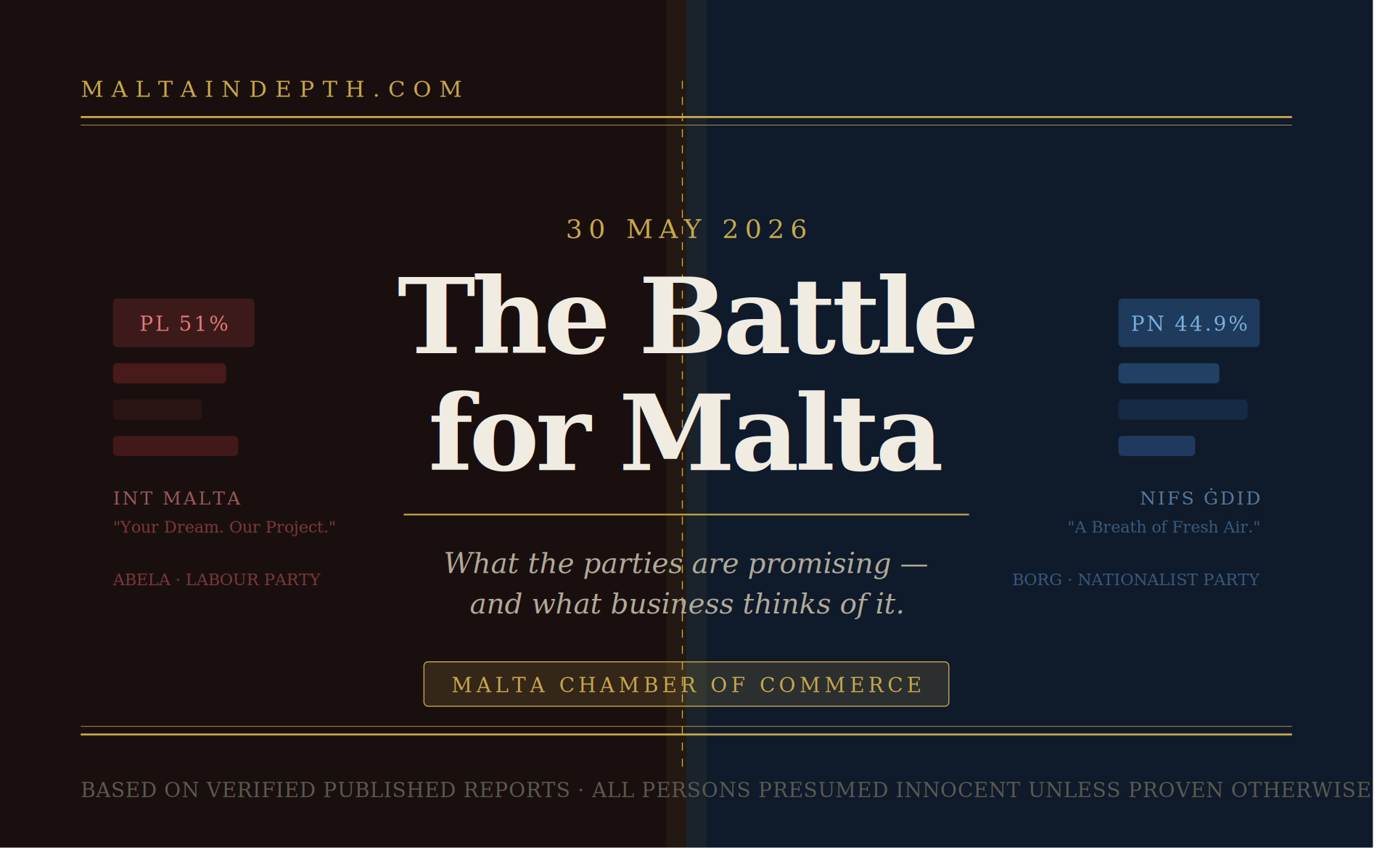
    The Battle for Malta: What the Parties Are Promising and What Business Thinks of It

    Malta goes to the polls on 30 May 2026. The writ has been signed, parliament dissolved, and the billboards are up. After weeks of speculation, Prime Minister Robert Abela cited global geopolitical instability as requiring “a new mandate from the Maltese people” — a framing that conveniently skips over the fact that his government still had a year of its mandate remaining. The Nationalist Party, under its young leader Alex Borg, had barely settled into opposition mode when it was thrust into campaign footing.

    What follows is a factual account of what each party is saying, what it is prioritising, and what Malta’s business community makes of the whole exercise.


    THE ELECTORAL LANDSCAPE

    The polls tell a story of a race that is closer than Labour would like, and more distant than the PN needs. A MaltaToday survey in March 2026 placed Labour at approximately 48.2% and the Nationalist Party at 45.6%. A separate survey by Vincent Marmarà in February placed the gap wider — Labour at 52.8% against the PN’s 42.6%. The PolitPro aggregate poll trend, which weights multiple surveys, currently places Labour at 51% and the PN at 44.9%.

    In other words: Labour leads, but not comfortably. The PN, under Alex Borg — at 30, the youngest leader of a major party in Maltese history — is fighting on the premise that the gap is closeable if the right issues land. This is the first Maltese election fought fully in the age of AI-generated content, with both parties’ slogans already mocked and manipulated across social media within hours of the announcement.


    LABOUR: “INT MALTA — YOUR DREAM. OUR PROJECT”

    Robert Abela launched Labour’s campaign at Fort Tignè on 28 April, one day after calling the election. The slogan — Int Malta: Il-Ħolma Tiegħek. Il-Proġett Tagħna — translates as “You are Malta: Your Dream. Our Project.” It is a deliberately personal pitch, positioning Labour not as a party but as a mirror of the electorate itself.

    The Narrative

    Abela’s central argument is continuity and competence in uncertain times. He points to tax reductions, higher allowances, increased student stipends, assistance for first-time buyers, and sustained economic growth as evidence of delivery. He says Labour “remained focused” during global turbulence and is best placed to manage what lies ahead. He has framed the election explicitly as a choice between experience and risk.

    “On our part, we will act with maturity. We will not enter into any political bidding war where, whatever others propose, we promise more. We will present a plan that is feasible, well-studied, ambitious, and above all responsible,” Abela told supporters at the launch.

    Key Policy Proposals Announced So Far

    Economy and Families: Labour’s opening salvos were targeted squarely at households. Proposals announced in the first week of the campaign include increased child bonuses, higher pensions, higher student stipends, and financial support mechanisms for first-time property buyers. Abela has promised the manifesto will be “fully costed” — a first for Malta — and will include a “wellbeing index” tied to 25 specific targets to measure real-life policy impact over the legislature.

    Gozo: On 29 April, Labour announced free Gozo Channel ferry crossings for foot passengers (excluding vehicles), a €45 million interconnector upgrade, modernisation of all Gozitan schools, and a road repair programme across the island.

    Quality of Life: Abela has repeatedly stated that quality of life will be the central theme of the next Labour government. This includes increased maternity and parental leave provisions, and a broader welfare package aimed at young people and the elderly.

    What Remains Vague: The full manifesto had not been published at the time of writing. Despite promises of a “costed” plan, the detail behind the headline numbers remains limited. The wellbeing index — while rhetorically interesting — has yet to be defined in any substantive way.


    NATIONALIST PARTY: “NIFS ĠDID — A BREATH OF FRESH AIR”

    Alex Borg unveiled the PN’s slogan — Nifs Ġdid — at a press conference days after the election announcement. He explained the phrase came directly from conversations on doorsteps, in businesses, and at workplaces across Malta and Gozo. People, he said, are exhausted: by traffic, by rising costs, by a sense that the economy grows but the benefits don’t reach them, and by “a broken government.”

    The message is framed around the concept of Malta hija tal-poplu — “Malta belongs to the people” — in a direct contrast to Labour’s personalised Int Malta appeal.

    The Narrative

    Borg’s pitch is calibrated around fairness and renewal. He acknowledges Labour’s economic record but insists it has failed to translate into better everyday lives. “57% of workers in Malta experience stress — higher than the EU average,” he told supporters at the May Day rally in Lija. “The economy is expanding, but ordinary citizens are not truly experiencing the gains.”

    He has also been blunt about Labour’s governance failures: “We have an important decision to take. We have the country’s future in our hands.” He invoked the memory of Eddie Fenech Adami to remind supporters of what PN leadership historically looked like, and positioned himself as a new chapter in that tradition.

    Key Policy Proposals Announced So Far

    Health — The Centrepiece: Borg has made healthcare the flagship priority of the campaign. The PN’s first week was dominated by health proposals, including the construction of two new hospitals — one in Gozo (€350 million, 400 beds, with a helipad) and one in the north of Malta — the transformation of the Paola health hub into a full hospital, and the conversion of Selmun Palace into a national health village with Fort Campbell as a wellbeing park. The Victoria Health Centre in Gozo would operate 24 hours a day. Borg cited the Vitals/Steward concession scandal, which cost the country €400 million and is the subject of criminal proceedings against former Prime Minister Joseph Muscat, as the definitive proof that Labour “abandoned” healthcare.

    Transport: Borg pledged a mass public transport system operational within five years. He was careful to distinguish this from what he called “flashy” government announcements, insisting the PN’s proposal would come with a binding contract.

    Gozo — Regional Status: The PN announced over 100 Gozo-specific proposals. These include the formal establishment of Gozo as a region through a parliamentary resolution, a new passenger ferry vessel operational by 2029 (with half-hourly peak-hour service and extended weekend night services), an expansion of Mġarr Harbour, improvements at Ċirkewwa, and construction of the long-promised Marsalforn breakwater. This is the most detailed Gozo-focused package either party has ever presented.

    Tax and Finances: The PN proposed removing tax on the first €10,000 of overtime and part-time income, tax exemptions for pensioners earning up to €37,000, and a Child Trust Fund giving every child a financial foundation for their future.

    Immigration and Economy: The PN website states plainly: “The answer to Malta’s future cannot always be more people.” It advocates raising skills, improving wages, and using technology to create a higher-value, lower-volume economy — a direct challenge to Labour’s reliance on population growth and foreign labour as economic drivers.

    Environment: The PN has committed to a National Park Designation and Protection Act, building on the recent reclamation of Manoel Island, Selmun, and White Rocks as public spaces.

    What Remains Vague: Like Labour, the full manifesto had not been published at time of writing. The costing of two new hospitals, a new ferry, harbour expansions, and a mass transit system within a single legislature has not been fully explained. Borg has acknowledged the PN is the underdog.


    THE CHAMBER OF COMMERCE: “POPULISM CANNOT DICTATE ECONOMIC POLICY”

    While both parties have been competing to out-promise each other, Malta’s business community has watched with alarm. The Malta Chamber of Commerce, Enterprise and Industry delivered its verdict in the bluntest possible terms.

    In an open letter signed by Chamber President William Spiteri Bailey and addressed directly to both Abela and Borg, the Chamber said it was looking at the opening week of the campaign “with serious concern.” It warned that several proposals from both parties, if implemented, would “directly harm the business community and Malta’s wider economy.”

    The Core Charge: “What we are currently witnessing is a departure from these principles, in favour of proposals that prioritise immediate electoral appeal over national interest,” Spiteri Bailey wrote. He added: “Populism cannot be allowed to dictate economic policy.”

    The Chamber’s specific concerns include:

    • Labour’s welfare expansion, particularly increased bonuses, higher stipends and enhanced leave provisions, which it fears could further distort an already strained labour market.
    • The PN’s higher stipend proposals, which the Chamber considers to exceed even Labour’s own offers — describing this as a competitive bidding war that serves neither party well.
    • Both parties’ failure to address productivity, competitiveness, and labour supply in a meaningful structural way.
    • The contradiction between the promises being made and the government’s own Vision 2050 strategy, which “calls for a long-term, productivity-driven, and value-focused economic model.”

    “Any proposal put forward must be assessed not on its popularity, but on its feasibility and its impact on productivity, competitiveness, labour supply, and long-term economic sustainability,” Spiteri Bailey wrote. He reminded both leaders pointedly that “political cycles may span four or five years — the consequences of poor economic decisions endure far beyond that.”

    The Chamber’s warning is more pointed for its evenhandedness. It did not single out one party. It called out both — which, in Malta’s deeply tribal political culture, is itself an act of some institutional courage. The letter represents a formal break between the business establishment and the promises being made on the campaign trail by both parties.


    THE ELECTORAL CONTEXT

    This election takes place against a backdrop that neither party has chosen to fully confront:

    • Joseph Muscat, the former Labour Prime Minister who won the two largest majorities in Maltese history, is currently facing criminal proceedings related to the Vitals/Steward hospitals concession. He is the ghost at this electoral feast — too electorally toxic to be mentioned by Labour, too popular with Labour’s base to be entirely abandoned.
    • Daphne Caruana Galizia’s murder, the public inquiry into which identified systemic failures of governance, remains an open wound. Three men have been convicted of the killing; the prosecution of Yorgen Fenech as alleged mastermind continues.
    • The FATF greylisting of 2021, from which Malta was eventually removed, has left lasting damage to the country’s financial services reputation — damage the Chamber continues to flag.
    • Transparency, or its absence: the Commissioner for Standards has publicly condemned the downgrading of ministerial asset declarations, and unexplained wealth orders remain absent from Maltese law.

    The election, in short, is about more than hospitals and ferry frequencies. It is about whether Malta, having lived through a decade of governance failures, chooses accountability or continuity, renewal or more of the same.

    Voters will decide on 30 May.


    This article is based on verified published reports from The Malta Independent, MaltaToday, The Shift News, Lovin Malta, Newsbook, the Malta Chamber of Commerce, and the PolitPro polling aggregator. All polling data is subject to the published margins of error.