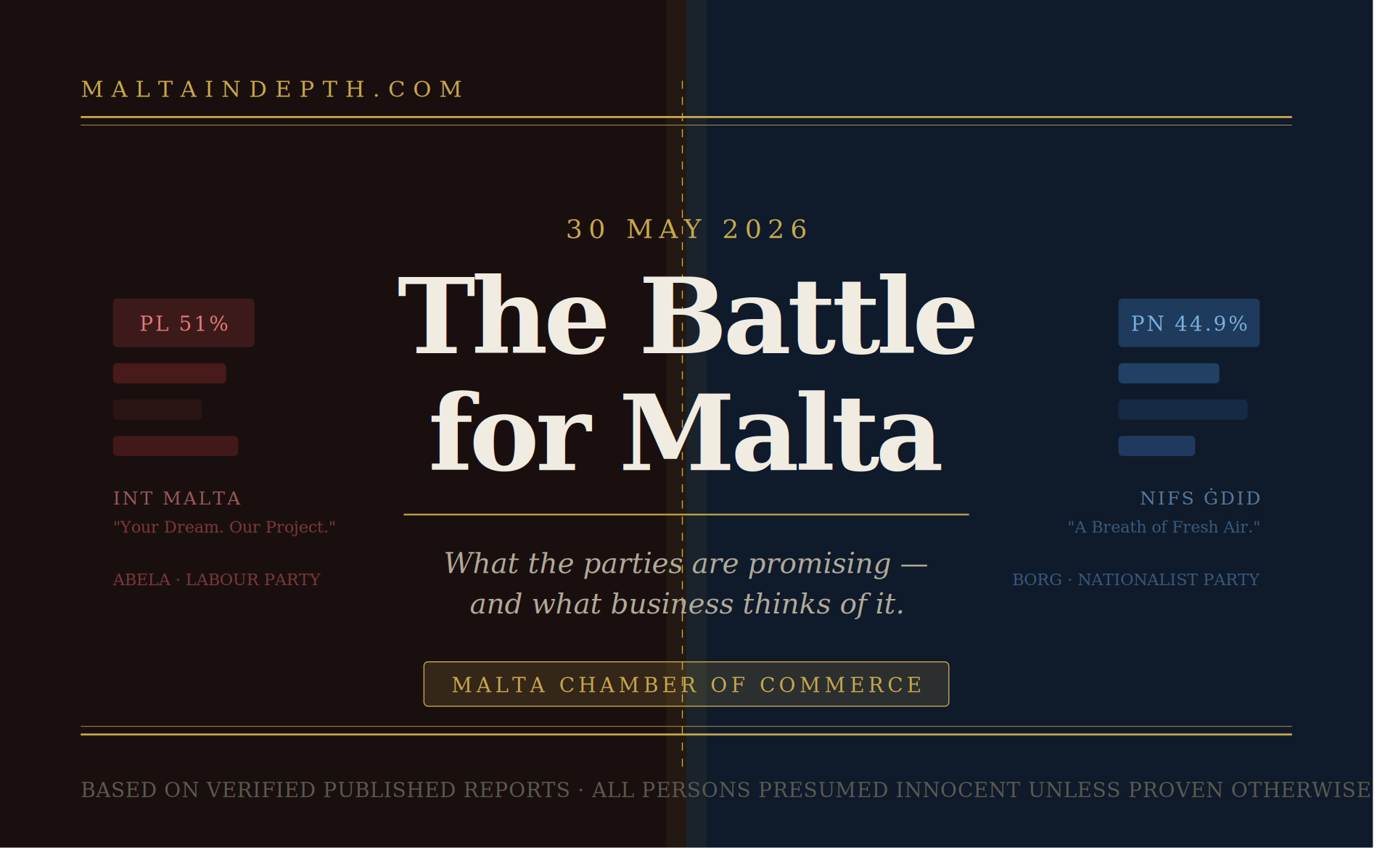
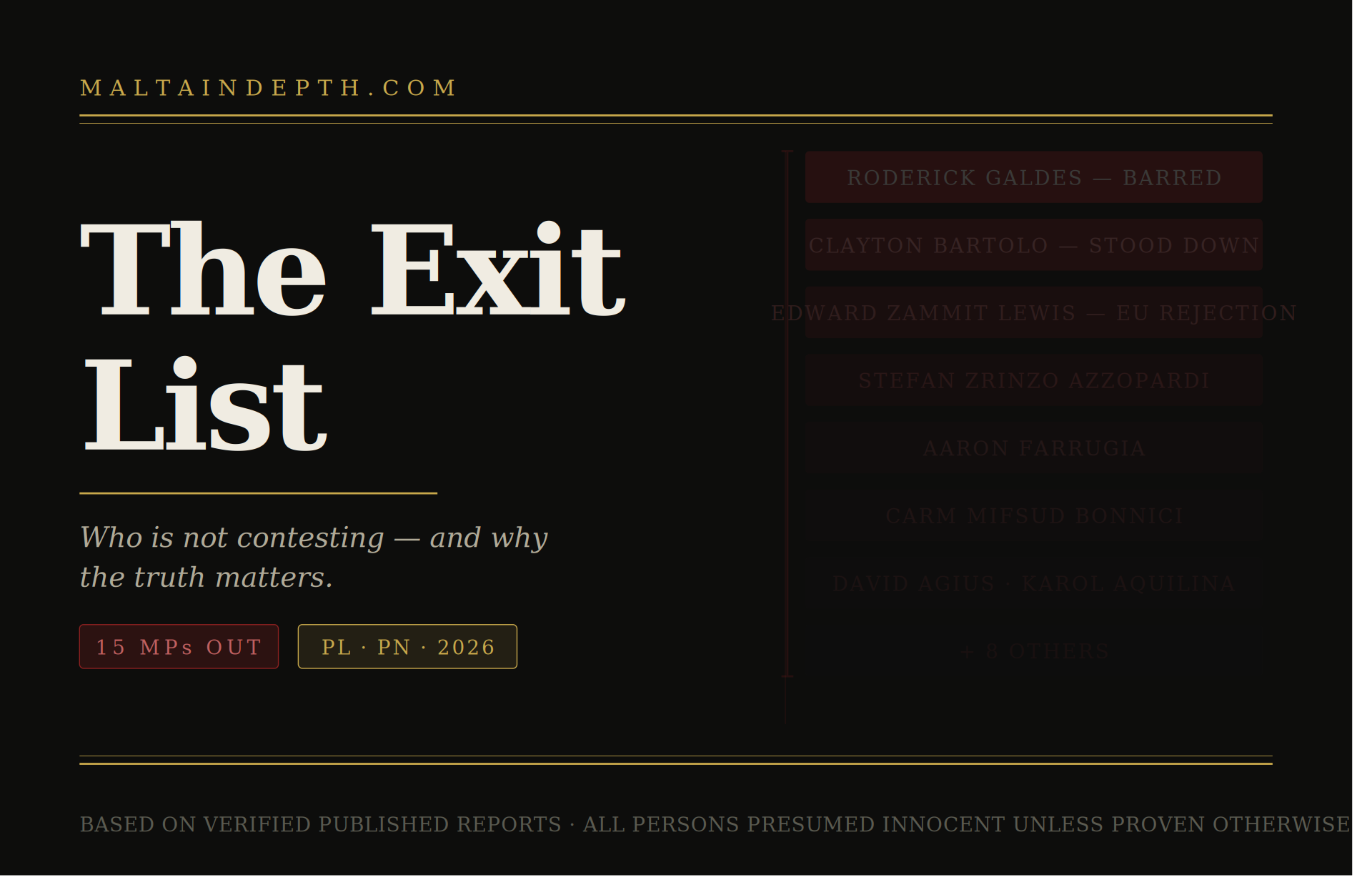
Every general election produces two lists: those seeking power and those stepping away from it. In a healthy democracy, the second list reflects natural rotation — experience making way for fresh talent, older hands passing the baton. In Malta’s 2026 general election, the exit list tells a more complicated story.
At least 15 sitting Members of Parliament will not contest on 30 May. Among them are ministers who resigned under pressure, MPs barred by their own party, figures whose conduct has drawn ethics scrutiny, and others whose departures appear closely tied to the governance controversies of the past decade.
This article examines each of them — what they have said, and what the public record shows.
PART ONE: THE LABOUR PARTY
Labour enters this election having parted ways, voluntarily or otherwise, with several figures whose conduct in government became publicly contested. The departures have been selective, and several notable absences from the exit list are themselves part of the story.
RODERICK GALDES — BARRED FROM CANDIDACY
Former Minister for Housing, Social Accommodation and Social Care
Roderick Galdes resigned from Cabinet in January 2026 amid sustained pressure over reported personal property dealings and questions about family connections to social housing contractors that had benefited from government direct orders. According to reporting at the time, the allegations centred on whether major public housing projects had been used to benefit politically connected individuals.
Former Labour MEP Marlene Mizzi publicly accused him of “hobnobbing with contractors,” alleging that he had cultivated relationships with developers and businessmen who profited from government housing schemes.
Despite resigning from Cabinet, Galdes remained within the Labour parliamentary group and had reportedly been campaigning in the weeks before the election announcement, attending public events as if his candidacy were settled. Prime Minister Abela appeared willing to accommodate him on the party ticket.
The Labour Party executive saw it differently. According to reporting, in a secret ballot held on 28 April — one day after former Tourism Minister Clayton Bartolo confirmed his own withdrawal — a majority of the party executive voted to block Galdes from contesting.
Galdes reacted strongly. In a public statement, he insisted his decision was “not a retreat but a strategic move to ensure the best possible result” for the party, dismissed the allegations against him as “baseless slanders,” and said the truth would “eventually emerge to clear his name.” He also publicly attributed his exclusion to the Nationalist Party — despite the vote being an internal Labour matter.
The episode is unusual in Maltese politics: a party taking internal action to remove one of its own from a ticket, against the apparent inclination of its leader.
CLAYTON BARTOLO — STOOD DOWN
Former Minister for Tourism
Clayton Bartolo was once seen as a rising figure within Labour, having presided over the post-pandemic recovery of Malta’s tourism sector. His political trajectory shifted in late 2024.
He was forced to resign as Tourism Minister following revelations about his then-girlfriend (later wife) Amanda Muscat. A Standards Commissioner investigation found that Bartolo, together with Gozo Minister Clint Camilleri, had abused their ministerial power by awarding Muscat a series of government promotions across their respective ministries — promotions that, according to the Commissioner’s findings, allowed her to receive a salary without fulfilling her duties for 13 months. Reports cited approximately €50,000 in irregular transactions over six months through a company linked to a Malta Tourism Authority contractor. Bartolo resigned from Cabinet and from the Labour parliamentary group, though he remained in the House as an independent.
He was reportedly seeking a return to the Labour fold in time to contest the 2026 election. That ambition ended on 27 April when he announced on Facebook that he would not be contesting, citing his expectation that “a disgusting and vile attack” would be levelled against him and his family during the campaign. According to The Shift News, Bartolo was asked by Prime Minister Abela to step aside, with reporting suggesting an investigation involving his wife was a factor — making the withdrawal less a personal decision and more a managed exit.
EDWARD ZAMMIT LEWIS — DEPARTING
Former Minister for Justice; former Minister for Tourism; former Minister for European Affairs and Equality
Edward Zammit Lewis announced he will not contest after thirteen years in parliament and multiple ministerial portfolios. He cited family considerations and a wish to return to private legal practice. His statement was warm in tone and emphasised continued loyalty to Abela.
The public record around Zammit Lewis is extensive and worth setting out plainly.
Zammit Lewis is a long-standing personal friend of former Prime Minister Joseph Muscat. According to reporting, he accompanied the Prime Minister on a 2017 holiday in France, the costs of which — based on subsequently published reporting — were covered by Yorgen Fenech, the businessman later accused of complicity in the assassination of journalist Daphne Caruana Galizia. Fenech denies the charge against him; proceedings remain ongoing.
In January 2019, leaked WhatsApp messages later published by media outlets indicated that Zammit Lewis had directly messaged Yorgen Fenech to mock calls by then-Opposition leader Simon Busuttil for an investigation into the company 17 Black, which Fenech owned. According to those messages, Zammit Lewis also referred to Labour supporters using a derogatory Maltese term. When the messages became public in 2021, civil society groups Repubblika and AD+PD called for his resignation. He declined to resign, characterising his acquaintance with Fenech as already publicly known. He remained in post.
The financial dimension is also part of the public record. According to reporting, during a period in which he was outside Cabinet — following the 2017 election, when he required a casual election to retain his seat and was not appointed to government — his law firm received a series of direct orders from governmental bodies, including Identity Malta, the Lands Authority, and the National Development and Social Fund. He also reportedly served as a consultant to then-Energy Minister Konrad Mizzi, a central figure in the Electrogas and Vitals controversies. Separately, reporting indicated that Fenech offered Zammit Lewis the ability to employ his political supporters within the Tumas Group; Zammit Lewis later characterised this as “a normal practice among politicians.”
Zammit Lewis served as Justice Minister from January 2020 to February 2022, and oversaw judicial reforms during a period in which the Caruana Galizia murder case and Venice Commission reform process were unfolding simultaneously. He was not reappointed to Cabinet after the 2022 election.
In June 2024, Prime Minister Abela nominated Zammit Lewis as Malta’s judge at the EU General Court — an appointment that, if successful, would have placed him in a long-term judicial role at a European institution. According to reporting by MaltaToday, Zammit Lewis was the government’s preferred candidate from the outset, though the nomination was processed through an open call. In December 2024, the EU General Court’s independent advisory panel — the Comité 255 — rejected the nomination. He did not take up the post.
His public statement on his departure does not address this record. It describes a career of public service, a party he loves, and a family he is grateful to. Readers can draw their own conclusions about what is being left out.
STEFAN ZRINZO AZZOPARDI — NOT CONTESTING
Former Minister for Public Works and Planning; Minister for European Funds
Zrinzo Azzopardi’s announcement in November 2025 that he would not contest was framed in the language of personal choice: family time, a return to legal practice, gratitude to constituents. According to reporting by The Malta Independent, the broader context was different.
After the 2022 election, Zrinzo Azzopardi was appointed to significant portfolios — Public Works and Planning, then Public Lands. According to reporting, his trajectory shifted in May 2025, when a cabinet reshuffle moved him to EU funds. He had also faced scrutiny over controversies involving a tract of agricultural land in his district. The Malta Independent reported that the relationship between him and the Prime Minister had become “strained,” and described the loss of the Lands Authority portfolio to Owen Bonnici as “likely the final confirmation” that his political position was no longer secure.
The Independent characterised his departure as “not just another retirement” but a symptom of a government “shrinking inward, narrowing its talent pool, and rewarding proximity over performance” — a framing reflecting that publication’s analysis.
AARON FARRUGIA — NOT CONTESTING
Former Minister for Transport, Infrastructure and Capital Projects
Aaron Farrugia served as Transport Minister in the 2022–2026 legislature but was removed from the portfolio mid-term and replaced by Chris Bonett. He has confirmed he will not contest, citing personal reasons, and has kept a low public profile since his removal. His departure follows a tenure in which Malta’s traffic crisis became one of the country’s most visible policy challenges.
MICHAEL FARRUGIA — NOT CONTESTING
Former Minister for Health and Social Policy
Michael Farrugia served as Health Minister in a previous legislature but was not given a ministerial portfolio in the 2022 parliament. His decision not to contest reflects the difficulty of an MP without ministerial role and limited first-preference vote base seeking another term.
CHRIS AGIUS — NOT CONTESTING
MP for the 9th District
Chris Agius has confirmed he will not contest. No significant governance controversy is publicly attached to his name. His exit appears to be a straightforward generational change.
A NOTABLE ABSENCE: ROSIANNE CUTAJAR
It would be incomplete to discuss Labour’s exit list without noting who is not on it.
Rosianne Cutajar — the MP whose extensive WhatsApp correspondence with murder suspect Yorgen Fenech became public in 2021, who was found by the Standards Commissioner to have failed to declare cash and a Bulgari handbag received in connection with a property brokerage matter, and whose conduct has been the subject of multiple ethics inquiries — is reportedly contesting this election. She was not removed from the Labour ticket. She was not expelled from the parliamentary group.
Her continued candidacy, set against the exits of Bartolo and Galdes, raises questions about how Labour’s internal accountability decisions are made. On the available evidence, the operative standard appears more electoral than ethical.
PART TWO: THE NATIONALIST PARTY
The PN’s exit list is dominated less by governance controversies and more by a combination of age, internal politics, and a generational shift under the leadership of Alex Borg.
CARM MIFSUD BONNICI — RETIRING
Former Minister; MP for six consecutive legislatures
Mifsud Bonnici’s announcement on 1 May that he would not contest closed a chapter in one of Maltese politics’ best-known dynasties. His grandfather was “Il-Gross” Mifsud Bonnici, remembered as a notable parliamentary orator. His father, Ugo, served as President of the Republic. Carm was first elected in 1998 and has served six consecutive terms. In his Facebook video, he said simply: “Every beginning has an end.” No controversy is publicly associated with his departure.
DAVID AGIUS — NOT CONTESTING
Former Deputy Leader of the PN
David Agius served as deputy leader of the PN through some of its most difficult years in opposition. His decision not to contest reflects both the generational change under Borg and the wider realignment of the party’s senior figures. No governance issue is publicly associated with his exit.
CLAUDETTE BUTTIGIEG — RETIRING
MP; former party official
Buttigieg had announced publicly that the outgoing legislature would be her last in the House. Her exit is one of several departures of female MPs that has prompted public discussion about the gender balance of the PN’s incoming candidate list.
RYAN CALLUS — RETIRING
MP; opposition spokesperson
Like Buttigieg, Callus had announced publicly that this would be his last legislature. He is notable in this cycle as the MP whose parliamentary question publicly established that the Victorian milestone found at Minister Refalo’s residence had been quietly returned to Heritage Malta, more than a year after the fact.
IVAN J. BARTOLO — WITHDRAWING
MP; former opposition spokesperson
Ivan Bartolo’s withdrawal was among the most candid of the cycle. He told media his decision was driven by what he described as a “gradual erosion of the motivation and purpose” that had pushed him into public life, and that the “drama and disorder” he had witnessed in parliament had made his original vision for cross-party collaboration feel “naive in retrospect.” His statement was a rare piece of unvarnished political honesty. No governance controversy is associated with his exit.
ROBERT CUTAJAR AND CHRIS SAID — NOT CONTESTING
Both veteran PN MPs have confirmed they will not contest. No governance controversies are publicly attached to either name. Their exits appear to form part of the broader generational renewal under Borg.
KAROL AQUILINA — NOT CONTESTING
Former Shadow Minister for Justice
Aquilina’s absence from the candidate list is notable. He served as shadow justice minister and was one of the PN’s more forensic critics of Labour’s governance record. The internal PN process that led to his removal from the candidate list has not been publicly explained in detail. His absence removes one of the party’s more legally rigorous voices on justice and accountability themes — a question worth more public discussion than it has received.
THE BROADER PICTURE
Standing back from the individual cases, three patterns emerge from the exit list.
First: Selective accountability on the Labour side. The party has parted ways with figures whose conduct had become too publicly contested to retain — Galdes, Bartolo, and to a degree Zrinzo Azzopardi. Yet the selectivity is striking. Edward Zammit Lewis — whose record includes documented social and professional connections to Yorgen Fenech, leaked WhatsApp messages mocking calls for an investigation, direct orders to his law firm during a backbench period, and an EU judicial nomination rejected by an independent European panel — departs with a warm public statement and few questions raised. Rosianne Cutajar contests. Anton Refalo contests. The pattern that emerges is not strictly ethical; it appears closer to a calculation about electoral manageability.
Second: A governance vacuum at the centre. Labour is losing experienced ministers — some forced out, some apparently disillusioned — while making continuity and stability central to its electoral message. The tension between that message and the scale of ministerial turnover is one the party has not chosen to address publicly.
Third: The PN’s generational gamble. The PN’s departures are predominantly voluntary and uncontroversial. The party is consciously shedding its older generation to make space for new faces under Borg’s leadership. The risk is a thin and inexperienced new candidate list. The case of Karol Aquilina, whose removal has not been fully explained, suggests the renewal process is not without its own internal questions.
In both parties, those most associated with the governance controversies that have defined the past decade are largely still present. Many of the figures who held office during the most contested years of recent Maltese political history remain on their party tickets.
The 30 May ballot will determine whether that fact matters to the Maltese electorate. The historical record suggests it may not. The institutional record insists it should.
This article is based on published reports from The Shift News, The Malta Independent, MaltaToday, Lovin Malta, Newsbook, and the public Wikipedia record of the 2026 Maltese general election. All individuals are presumed innocent unless proven otherwise by a court of law.